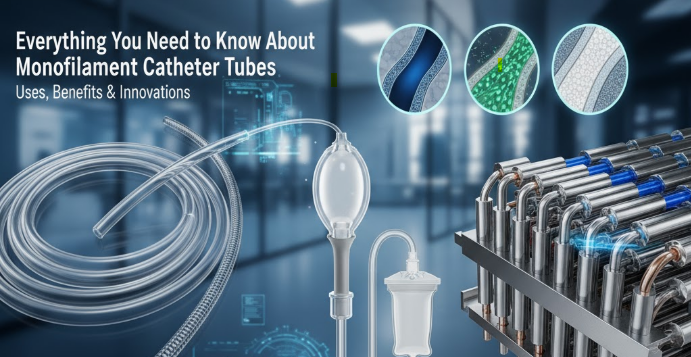
In today’s rapidly advancing world, tubing technology plays a vital role in both medical and industrial sectors. From life-saving catheters to precision heat exchanger tubes, these components ensure safety, efficiency, and functionality. The use of monofilament catheter tubes, Foley catheter tubes, heat exchangers tube, and catheter linings showcases how materials science and engineering intersect with healthcare innovation.
A monofilament catheter tube is a single continuous filament structure used in catheters and other medical tubing applications. Unlike multi-filament tubes, monofilament designs are smoother and more consistent, reducing the risk of bacterial buildup and tissue irritation.
Monofilament tubes are widely used in vascular catheters, urinary systems, and drug delivery devices, as well as in laboratory and microfluidic equipment.
The Foley catheter tube is a soft, flexible tube inserted into the bladder to drain urine. It features a balloon near the tip that inflates to keep it in place, ensuring continuous drainage for patients who cannot urinate naturally.
Foley catheters are often made from latex, silicone, or PTFE coatings, which ensure biocompatibility and minimize infection risks. Silicone versions are particularly valued for long-term use due to their durability and non-reactive nature.
Selection depends on patient condition, catheter size, tip type, and duration of use. Medical professionals often prefer all-silicone catheters for chronic cases due to reduced irritation.
In industrial and medical systems, heat exchangers tubes transfer heat between fluids efficiently without direct contact. In healthcare, they’re found in dialysis machines, cryotherapy systems, and respiratory care units.
Common types include stainless steel, copper, and titanium tubes, selected for their thermal conductivity and corrosion resistance. Advanced PTFE-lined tubes improve chemical stability and longevity.
Beyond healthcare, heat exchanger tubes are essential in energy systems, HVAC units, and food processing industries.
Catheter linings are specialized coatings applied inside or outside catheter tubes to improve lubricity, chemical resistance, and patient comfort.
Enhanced linings reduce friction, extend catheter life, and improve biocompatibility, ensuring safer and smoother medical procedures.
Modern production involves extrusion, monofilament spinning, and coating technologies. Quality assurance ensures precision in wall thickness, diameter, and tensile strength — crucial for patient safety and performance reliability.
Materials like silicone, polyurethane, PVC, and PTFE dominate the tubing industry. Innovations focus on biocompatibility, flexibility, and environmental sustainability, with research exploring bio-based polymers and antimicrobial surfaces.
Manufacturers must comply with ISO 10993, FDA, and EU MDR standards. Each product undergoes rigorous testing for biological safety, mechanical integrity, and sterility assurance.
The move toward eco-friendly materials and closed-loop recycling has transformed tubing production. Companies now prioritize low-carbon manufacturing and responsible waste management.
Emerging trends include:
These innovations promise to redefine patient care and industrial efficiency alike.
The future of monofilament catheter tubes, Foley catheter tubes, heat exchangers tube, and catheter linings lies in precision engineering, smart materials, and eco-conscious design. As technology evolves, these components will continue improving patient outcomes and industrial efficiency — shaping a safer, more sustainable future.