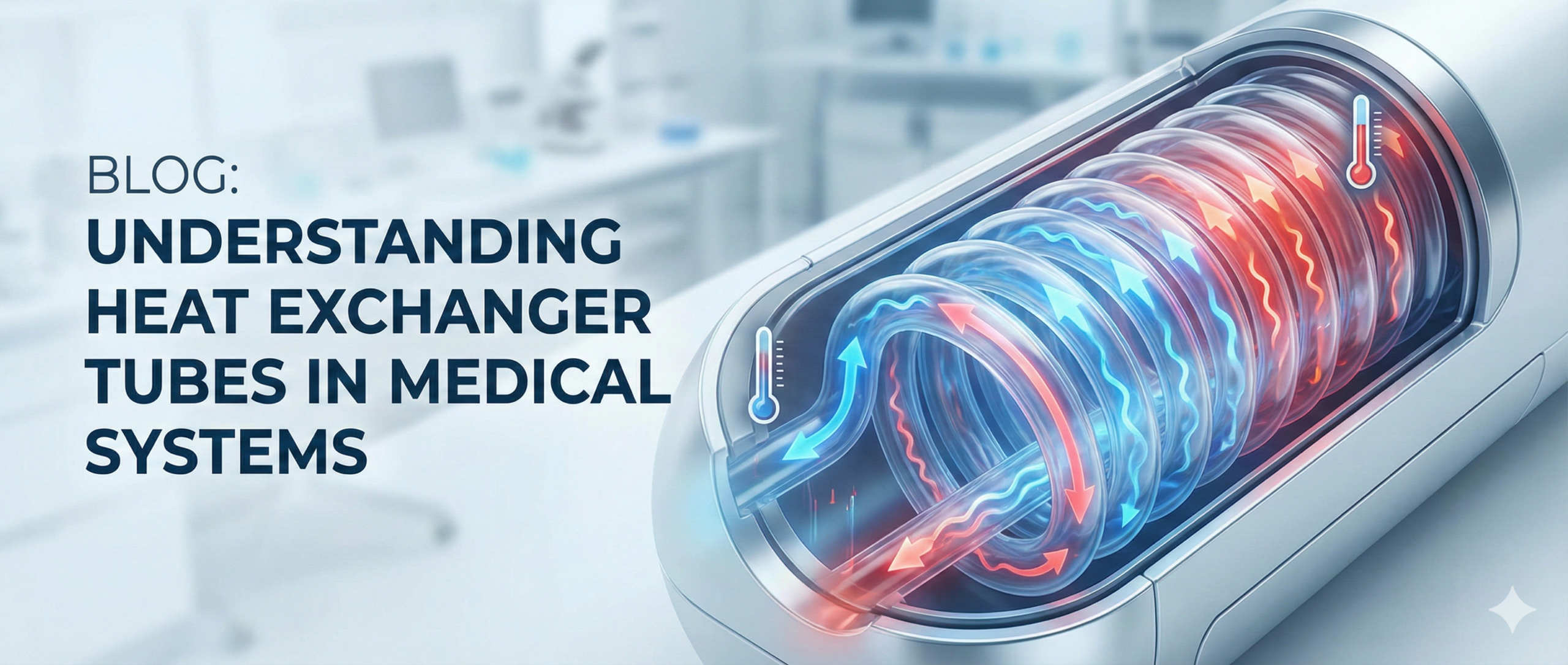
A 2024 study demonstrated a low-cost blood/fluid warmer built from a dual-tube heat-exchanger concept (passive heat transfer), showing this design’s relevance for medical warming and dialysis applications.
Heat-exchanger tubes are the internal flow passages in devices that transfer heat between two fluids (one in the tube, one outside). In medical equipment they’re used where precise warming, cooling, or humidification of blood, IV fluids or respiratory gases is required — often demanding biocompatible materials, smooth surfaces and tight tolerances.
Heat-exchanger tubes form the core of shell-and-tube, double-pipe and microchannel exchangers.
Material choice (stainless steel, copper alloys, titanium, or specialty polymers/PTFE liners) drives performance and corrosion resistance.
Medical uses include blood/IV warmers, dialysis heat control, and heat-moisture exchangers (HMEs); designs focus on low shear, sterilizability and safety.
PTFE-lined or extruded polymer tubes are used where chemical inertness or non-stick surfaces are needed; companies like Yash Dynamics supply medical-grade PTFE tubing suitable for some heat-exchanger components.
A heat-exchanger tube is a pressure-rated tubular element that carries one fluid while the surrounding shell or adjacent flow carries the other. In shell-and-tube exchangers the tubes are bundled inside a shell and can be arranged in single or multiple passes to control the thermal duty and pressure drop.
Why tube geometry matters: tube diameter, wall thickness, rifling (internal grooves), finning and cross-section all change heat transfer coefficient and fouling behavior. Engineers pick geometries to balance heat transfer, pressure drop and cleanability.
Shell-and-tube (tube bundles) — most widely used for heavy duty and scalable medical systems (multi-pass designs improve thermal performance).
Double-pipe (coaxial/dual-tube) — one fluid inside an inner tube and the other in the annulus; simple and ideal for small-scale medical warmers. (Used in some low-cost blood warmer designs.)
Microchannel / plate-style (not strictly “tubes”) — compact, high-area devices used where small volume and rapid response matter.
Stainless steels (304L, 316L, duplex): excellent corrosion resistance, mechanical strength and sterilizability — common for medical heat exchanger tubes.
Copper and copper alloys: very high thermal conductivity — used in condensers/heat recovery but less common in blood contact due to biocompatibility concerns.
Titanium and high-nickel alloys: chosen for aggressive chemistries or saline environments when corrosion resistance is critical.
Polymers / PTFE liners (or full PTFE tubes): used where chemical inertness or extremely low friction is required — e.g., catheter liners, some heat-exchanger flowpaths in medical devices. Yash Dynamics is one supplier that offers medical-grade PTFE extruded tubes and Ptfe liners used in catheter and heat-exchanger applications.
Medical device heat exchangers must meet additional constraints beyond industrial units:
Biocompatibility: blood contact surfaces must not trigger hemolysis or clotting.
Low shear & smooth inner surface: to protect blood cells and minimize fouling.
Sterilizability & cleanability: withstand autoclave, chemical sterilants or single-use design.
Precise thermal control: avoid overheating blood/fluids — small errors can harm patients.
Blood / IV fluid warmers: dual-tube and coiled-tube arrangements provide rapid, passive warming just before infusion. A 2024 design used a dual-tube heat-exchanger approach to build a low-cost, effective blood warmer.
Dialysis systems: heat exchange maintains dialysate temperature; microchannel or small tube exchangers are used for space and precision.
Heat-Moisture Exchangers (HMEs): disposable devices that recover heat and humidity from exhaled breath for ventilated patients (commonly not metal tubes but a heat-exchanging media).
Define thermal duty (ΔT, flow rates, required outlet temperature).
Choose configuration: double-pipe for small, shell-and-tube for larger flow or serviceability.
Select material by biocompatibility, corrosion environment and sterilization method.
Minimise dead volume and sharp edges; prefer electropolished or PTFE-lined interiors for blood contact.
Plan validation: thermal mapping, hemocompatibility tests, pressure/leak tests and cleaning cycles.
Regular inspection for fouling, pitting or micro-leaks; perform leak testing after sterilization cycles.
If using polymer liners, check for embrittlement after repeated sterilization.
Follow device-level validation (ISO 10993 for biocompatibility where applicable) and local medical device regulations.
Heat exchanger tubes play a silent but important role in modern medical devices. From blood warmers to dialysis systems, the right tube material and design ensure safe, precise, and reliable thermal control.
As medical technology advances, demand for high-performance, biocompatible tubing solutions—including PTFE-based systems—continues to grow.