
TEFLON SLEEVE FOR ELECTRICAL APPLICATIONS: THE COMPLETE GUIDE TO PTFE ELECTRICAL INSULATION
Every wire, conductor, and cable in a high-performance electrical system needs protection — from voltage spikes, heat, chemicals, and mechanical wear. The insulation material chosen to provide that protection determines whether the system operates reliably for years or fails prematurely.
Among all insulation options available to electrical engineers today, the Teflon sleeve stands apart. Composed of polytetrafluoroethylene (PTFE) — one of the most chemically inert and thermally stable polymers known to science — a Teflon sleeve delivers a combination of properties that no standard plastic or rubber insulator can match.
This guide covers everything engineers, procurement specialists, and system designers need to know about Teflon sleeves in electrical applications: what they are, why PTFE outperforms conventional insulation materials, where they are used, and how to specify the right sleeve for your system.
WHAT IS A TEFLON SLEEVE?
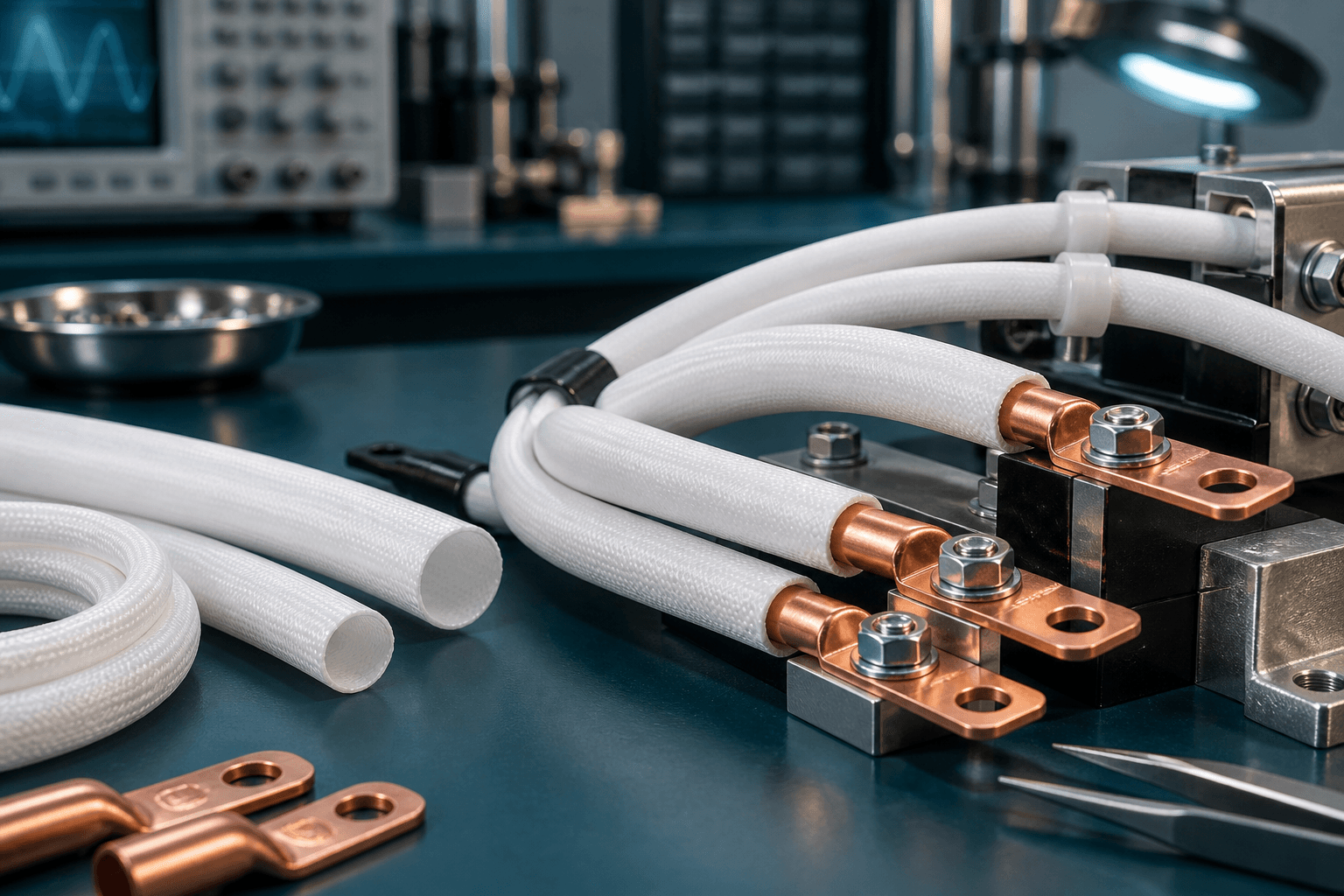
A Teflon sleeve — also known as a PTFE sleeve, PTFE tube, or PTFE insulation sleeve — is a precision-extruded hollow tube made from polytetrafluoroethylene that is slipped over wires, conductors, cables, or electrical components to provide electrical insulation, thermal protection, and chemical resistance.
The term “Teflon” is a registered trade name for PTFE developed by Chemours (formerly DuPont), but in industry practice, “Teflon sleeve” is widely used to describe any PTFE-based insulation sleeve regardless of manufacturer.
Unlike heat-shrink or moulded insulation, a Teflon sleeve is a cut-to-length extruded tube that slides over conductors before termination or is fitted over existing wiring during assembly. Its properties derive entirely from the PTFE polymer — not from additives, plasticisers, or coatings — making its performance exceptionally consistent and stable over time.
KEY PHYSICAL PROPERTIES OF A TEFLON SLEEVE
- Dielectric Strength: >60 kV/mm
- Operating Temperature: -200°C to +260°C continuous
- Dielectric Constant: ~2.1 (very low; near-perfect insulator across frequencies)
- Chemical Resistance: Resistant to virtually all acids, bases, and solvents
- Surface Energy: Extremely low (non-stick, non-wetting surface)
- Flammability: UL94 V-0 rated (self-extinguish)
- Density: 2.15–2.20 g/cm³
- Tensile Strength: 20–35 MPa
SECTION 2: WHY PTFE OUTPERFORMS STANDARD ELECTRICAL INSULATION
Standard wire insulation materials — PVC, polyethylene (PE), nylon, rubber — are adequate for low-voltage, ambient-temperature domestic and commercial applications. But in demanding industrial, aerospace, medical, and high-frequency environments, they fall short in multiple ways.
THE LIMITATIONS OF CONVENTIONAL INSULATION
- PVC: Softens above 70–90°C. Contains plasticisers that migrate and degrade over time. Poor chemical resistance. Emits toxic fumes if burned.
- Polyethylene (PE): Good dielectric properties but low thermal resistance (softens above 80°C). Susceptible to environmental stress cracking.
- Rubber / Silicone Rubber: Good flexibility but lower dielectric strength than PTFE. Silicone rubber degrades above 200°C and is susceptible to oil-based chemical attack.
- Nylon (PA): Absorbs moisture (hygroscopic), which degrades electrical insulation properties in humid environments.
HOW A TEFLON SLEEVE ADDRESSES EVERY LIMITATION
- Temperature: A Teflon sleeve performs continuously from cryogenic (-200°C) to +260°C, and survives short-term excursions to +300°C. No plasticisers, no softening, no degradation.
- Electrical Performance: PTFE has a dielectric constant of ~2.1 across a very wide frequency range — from DC to microwave frequencies. This consistency makes it the insulation of choice for high-frequency signal cables and coaxial systems where signal integrity is critical.
- Chemical Resistance: PTFE is resistant to virtually every industrial chemical including strong acids (hydrofluoric acid, sulphuric acid), strong bases, chlorinated solvents, and fuels. A Teflon sleeve will not corrode, swell, or contaminate even in the harshest process environments.
- Longevity: Unlike PVC (which becomes brittle as plasticisers migrate) or rubber (which oxidises and cracks), a PTFE sleeve is non-aging. Its properties do not change measurably over decades of service.
- Flame Resistance: PTFE does not support combustion. It is rated UL94 V-0 and does not produce burning droplets, making it critical for fire-safety-rated electrical systems.
ELECTRICAL APPLICATIONS OF TEFLON SLEEVES
The combination of high dielectric strength, broad thermal range, chemical inertness, and dimensional stability makes Teflon sleeves essential across a wide range of electrical and electronic applications.
APPLICATION 1 — HIGH-VOLTAGE (HV) EQUIPMENT INSULATION
High-voltage switchgear, transformers, capacitors, and bushings require insulation materials that maintain reliable dielectric performance under continuous electrical stress.
A Teflon sleeve used as a bus bar sleeve, terminal insulator, or wire insulation in HV equipment provides: Dielectric strength exceeding 60 kV/mm; Resistance to partial discharge and tracking; Thermal stability under fault current heating cycles; Zero moisture absorption (hygroscopic materials fail in HV applications as moisture reduces dielectric performance).
APPLICATION 2 — POWER TRANSMISSION WIRING
In power transmission and distribution systems — including switchboards, control panels, and motor leads — wiring often operates at elevated temperatures close to other heat-generating components. Teflon sleeves allow conductors to be routed through high-temperature zones (near motors, heaters, or transformers) without derating the insulation or increasing wire gauge to compensate for thermal degradation.
HIGH-FREQUENCY COAXIAL CABLES
The consistent low dielectric constant of PTFE (~2.1) across frequencies from audio to microwave makes Teflon-insulated coaxial cables the standard in: RF (radio frequency) transmission lines; Microwave and radar systems; Telecommunications infrastructure; Test and measurement equipment.
The low and stable dielectric constant ensures precise impedance matching (typically 50Ω or 75Ω) across wide frequency bands — a performance characteristic that PVC and PE dielectrics cannot reliably deliver at high frequencies.
APPLICATION 4 — INSTRUMENTATION AND THERMOCOUPLE WIRING
Industrial instrumentation wiring — carrying low-voltage signals from thermocouples, pressure transducers, flow meters, and analytical instruments — is frequently routed through environments with aggressive chemicals, high temperatures, or electromagnetic interference.
Teflon sleeves protect instrumentation wiring from: Chemical attack in process plant environments; Thermal degradation near furnaces or reactors; Moisture ingress in outdoor or condensing atmospheres; Mechanical abrasion in cable trays.
APPLICATION 5 — HEATING ELEMENT INSULATION
Resistance heating elements — used in industrial ovens, furnaces, semiconductor processing equipment, and food-processing machinery — operate at temperatures that immediately disqualify conventional insulation materials. PTFE sleeves are used to insulate the lead wires and termination connections of heating elements operating in environments up to 260°C, ensuring reliable electrical isolation and mechanical protection at the hottest points in the system.
APPLICATION 6 — MULTI-CORE AND SPECIALTY CABLE ASSEMBLIES
Complex cable assemblies for aerospace, defence, medical devices, and industrial automation require individual conductor insulation that is: Precisely dimensioned for tight multi-core bundling; Electrically consistent across the full length; Mechanically stable under repeated flexing; Compatible with high-temperature overmoulding processes.
Precision-extruded Teflon sleeves meet all these requirements with tight dimensional tolerances (typically ±0.05 mm on wall thickness) that are difficult to achieve with moulded or tape-wrapped insulation.
TEFLON SLEEVE TYPES AND SPECIFICATIONS
Not all Teflon sleeves are identical. Selecting the correct type requires understanding the differences in PTFE grade, wall thickness, inner diameter tolerance, and surface finish.
PTFE GRADES USED IN ELECTRICAL SLEEVES
- Virgin PTFE: The highest-purity grade, manufactured from unprocessed PTFE resin with no recycled content. Provides the best electrical and chemical performance. Required for medical, aerospace, and critical HV applications.
- Filled PTFE: PTFE compounded with glass fibre, carbon, or bronze fillers to improve mechanical strength, wear resistance, or thermal conductivity. Used in mechanical components more than pure electrical insulation. For Teflon sleeves used as electrical insulation, virgin PTFE is the standard specification.
WALL THICKNESS SELECTION
Wall thickness determines both electrical performance and flexibility: Thin-wall (0.1–0.3 mm): Maximum flexibility; used for fine wire insulation, thermocouple leads, and multi-core assemblies. Standard wall (0.3–1.0 mm): General-purpose electrical insulation for power wiring, instrumentation cables, and HV lead wires. Heavy wall (1.0 mm+): High mechanical protection; bus bar insulation, terminal sleeves, and HV equipment applications.
DIMENSIONAL STANDARDS
Inner Diameter (ID): Available from 0.3 mm (fine wire) to 100 mm+ (large bus bars). Tolerances: Typically ±0.05 mm ID; ±0.02 mm wall thickness for precision grades. Lengths: Cut to length or supplied in coils/continuous reels.
COLOUR OPTIONS
Natural (translucent white) PTFE is standard. Colour-coded Teflon sleeves (black, red, blue, yellow, green) are available for phase identification and cable management in multi-conductor systems.
TEFLON SLEEVE vs. OTHER HIGH-PERFORMANCE INSULATIONS
COMPARISON TABLE
| Property | Teflon (PTFE) | FEP | Silicone | PEEK |
|---|---|---|---|---|
| Max. Temp (cont.) | 260°C | 200°C | 200°C | 250°C |
| Dielectric Const. | ~2.1 | ~2.1 | ~2.8–3.5 | ~3.2 |
| Chemical Resist. | Excellent | Excellent | Good | Good |
| Flexibility | Moderate | High | Excellent | Low |
| Flame Rating | UL94 V-0 | UL94 V-0 | UL94 V-0 | V-0 |
| Moisture Absorb. | ~0% | ~0% | Low | Low |
| Cost | Moderate | Higher | Moderate | High |
KEY INSIGHT:
KEY INSIGHT: FEP (fluorinated ethylene propylene) is a melt-processable fluoropolymer with properties similar to PTFE. It is softer and more flexible, making it preferred for complex cable routing, but its maximum temperature is lower (200°C vs 260°C for PTFE). For the highest thermal demands and critical HV insulation, a Teflon (PTFE) sleeve remains the benchmark.
HOW TO SPECIFY A TEFLON SLEEVE
When specifying a Teflon sleeve for an electrical application, provide the following parameters to your manufacturer: Inner diameter (ID) required — match to conductor OD with appropriate clearance (typically 0.1–0.5 mm); Wall thickness required — based on voltage rating, mechanical protection needs, and space constraints; Length — cut-to-length pieces or continuous reel; PTFE grade — virgin PTFE for electrical applications; Colour — natural white or phase-coded colour; Dimensional tolerances required; Applicable standards — UL, MIL-SPEC, IEC, RoHS, REACH; Quantity and delivery schedule.
SPECIFICATION CHECKLIST
VOLTAGE RATING GUIDANCE
Voltage Rating Guidance: Wall Thickness 0.2 mm (Up to 1 kV); 0.5 mm (Up to 3 kV); 1.0 mm (Up to 7 kV); 2.0 mm (Up to 15 kV). Note: Voltage ratings depend on PTFE purity and surface quality. Always verify with your supplier’s test data and apply appropriate safety factors.
FREQUENTLY ASKED QUESTIONS (FAQs)
Q: What is a Teflon sleeve used for in electrical applications?
A: A Teflon sleeve is a PTFE-based insulation tube slipped over wires, conductors, and cables to protect them from high voltage, high temperatures, and chemical exposure. It is used across high-voltage equipment, power wiring, coaxial cables, thermocouple leads, and heating element connections.
Q: Why is PTFE the best material for electrical insulation?
A: PTFE has a uniquely high dielectric strength (>60 kV/mm), a very low and stable dielectric constant (~2.1) across all frequencies, zero moisture absorption, resistance to virtually all chemicals, and a continuous service temperature up to 260°C. No common alternative combines all these properties.
Q: What temperature range can a Teflon sleeve withstand?
A: A PTFE sleeve performs reliably from -200°C to +260°C continuously, with short-term tolerance to +300°C. This is the widest operating range of any commercially available electrical insulation material.
Q: Can a Teflon sleeve be used in high-frequency RF systems?
A: Yes. The low, stable dielectric constant of PTFE (~2.1) makes it the standard insulation for RF coaxial cables, microwave transmission lines, and radar systems where consistent impedance and minimal signal loss are critical.
Q: What is the difference between a Teflon sleeve and heat-shrink tubing?
A: A Teflon sleeve is a rigid or semi-flexible extruded tube that slides over conductors. Heat-shrink tubing contracts when heated to conform tightly to a surface. PTFE heat-shrink is available, but standard extruded Teflon sleeves are preferred where precise dimensional control, high dielectric strength, and maximum temperature resistance are required.
Q: Is PTFE insulation RoHS and REACH compliant?
A: Virgin PTFE is inherently free of restricted substances under RoHS and REACH regulations. It contains no lead, cadmium, mercury, hexavalent chromium, or restricted phthalates, making it fully compliant for use in electrical and electronic equipment supplied to European and global markets.
CONCLUSION
The Teflon sleeve is not simply a wire covering — it is a precision engineering component that enables electrical systems to operate safely and reliably in conditions that would destroy conventional insulation within hours. Its exceptional dielectric strength, thermal stability from cryogenic to 260°C, total chemical inertness, and non-aging performance make it the insulation of choice wherever electrical reliability cannot be compromised. From high-voltage switchgear to coaxial RF cables, from thermocouple leads in industrial furnaces to multi-core wiring harnesses in aerospace systems, the Teflon sleeve consistently delivers where other materials fail.
Yash Dynamics manufactures precision-engineered PTFE Teflon sleeves and components for demanding electrical applications using advanced vertical paste extrusion technology — producing high-quality, dimensionally consistent sleeves that comply with international standards. Standard and custom sizes are available for projects across the UK, US, Europe, and India. Contact Yash Dynamics to discuss specifications, custom dimensions, or volume requirements for your electrical insulation project.
